During our trip to Ålesund in Norway, we, Linnea Engblom and Josefine Nordberg Karlsson, two preschool teachers from Tortuna preschool in Västerås, had the privilege of visiting two kindergartens that left a strong impression on us. Both showed how care and safety can be combined with freedom and exploration, in ways that made us both admire and sometimes hold our breath.
Skåthaugen – the kindergarten where nature is the classroom
At Skåthaugen, a parent cooperative where outdoor life is not only an activity but a lifestyle, we were warmly welcomed by joyful teachers and children.
Here the staff work to build friendships between children of the same age across different groups. Four-year-olds meet in mixed groups to prepare for the next step: Hackespetthytta, a group for five-year-olds. This way, children build relationships before moving on to a new environment. A smart idea, we thought, strengthening both safety and community.
What stood out most was the view of children’s freedom. In Norway, children are allowed to do things that would rarely be accepted in a Swedish preschool yard: climbing higher, going closer to the edge, hanging in nets both on the playground and in the forest. In Sweden, principals, workplace authorities and insurance companies would be alarmed. In Ålesund, the only ones alarmed were the Swedish teachers. It makes you wonder: do Norwegian children get hurt less, or are we Swedes just a little overcautious? Perhaps it is exactly this freedom to try that helps children build courage and self-esteem.
Skåthaugen kindergarten clearly shows how nature, outdoor life and health are integrated into everyday routines. The children explore, experience, climb, taste and learn with their bodies. The vision “Out into life” is present in everything from forest shelters and mountain hikes to sowing seeds in their own garden beds.
Nørve – the kindergarten of structure and warmth
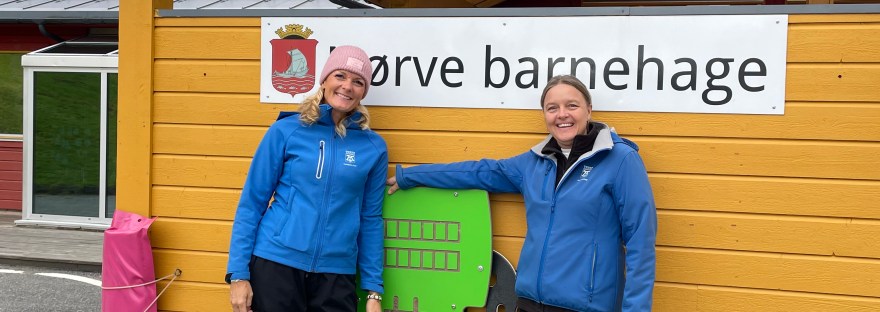
At Nørve kindergarten we met a leader, equivalent to our Swedish principals, who showed how structure can create safety. Booklets and documents described everything from vision and goals to detailed organization of everyday life. Nørve’s motto is as simple as it is powerful:
“Care and learning – yes please, both!”
What impressed us most was the attention to everyday situations. Each morning begins with eye contact and smiles, making sure children feel seen. Meals become arenas for language, humor and conversation. Teachers use every moment to create opportunities for meaningful dialogue with the children.
Workplace well-being was also a priority. Staff have four hours each week set aside for planning and reflection, and every day starts with a joint meeting for teachers from all groups if possible, otherwise one teacher carries the information from others. Their “Ten rules” for a good work climate emphasized the importance of starting the day with a smile, appreciating colleagues and daring to give constructive feedback. Talking with each other, not about each other, is a central value at Nørve kindergarten.
The role of the adult – awareness in every meeting
We were impressed by their view of the adult role. “Our work in the kindergarten is mainly about the children,” said the material we received. Adults should be present, positive and clear, good role models who never speak down to children, parents or colleagues.
Setting limits is described as an important part of care, not as control but as a way to create safety and predictability. Staff are encouraged to use “I” statements: “I want you to sit down on the chair.” Clear, respectful and warm.
Even the instructions for substitutes carried the same clarity: be present, always greet, ask if you are unsure, and remember that you are an ambassador for the kindergarten. Details that may seem obvious, but show how carefully Nørve builds its culture.
Similarities and differences
In both Skåthaugen and Nørve, play and language development were central themes, something we recognize from our own work in Tortuna. But the differences compared to Sweden were clear:
- Higher staff ratios gave better conditions for planning and reflection.
- Meals: while in Sweden the clock often rules and we must be back in time for lunch, Norwegian children walked longer tours with packed meals. Four days a week they eat sandwiches, which also seems to give more time for adventure.
- Freedom: children were allowed to try things on their own to a degree that is rare in Sweden, with all our safety rules.
Why children need risky play
At the end of our journey we had the privilege of listening to Charlotte Lunde, a doctor and child psychiatrist passionate about children’s mental health. She reminded us that children benefit from risky play. Research shows that climbing does not lead to more fractures and that rough-and-tumble play does not make children more aggressive. On the contrary, it strengthens courage, emotional regulation and self-confidence.
She also stressed that overprotective adults, both parents and preschools, risk preventing children from developing self-regulation. If we always remove risks, children never practice facing uncertainty, handling emotions and getting up when they fall.
Studies even show that adventurous play can reduce children’s anxiety. When children face challenges that are “just right,” they learn to cope with uncertainty – maybe the best investment in their future.
Our conclusion
We return home impressed by the Norwegian way of combining structure and freedom. Skåthaugen and Nørve showed different paths to the same goal: giving children safety, courage and joy in everyday life. In Sweden, we may need to talk more with principals, insurance companies and workplace authorities about not overprotecting children, because safety is not always the same as development.
Perhaps we also need to practice ourselves a little more: to dare to stay on the ground while the children climb higher. Who knows, maybe it is we adults who need the most training in self-regulation. During our trip it became clear that both Norway and Sweden want the best for children, but the way to get there looks different. Perhaps we Swedes can learn something from the Norwegian trust in children’s abilities.
So next time we see a child climbing a little higher than we are comfortable with, we might ask: is this dangerous, or is it learning?
Linnea Engblom and Josefine Nordberg Karlsson, Tortuna preschool Västerås

 Norsamby