
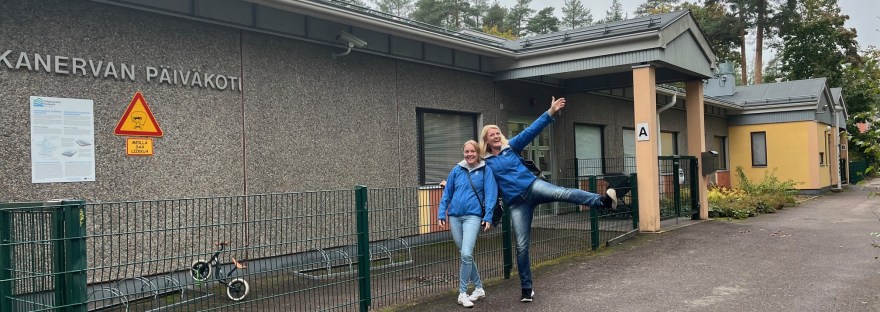
From the small village of Tortuna outside Västerås to the winter sports city of Lahti in southern Finland, we, two preschool teachers from Västerås, traveled. Together, we had the privilege of visiting and job shadowing at two preschools (Kanervan päiväkoti and Ersta päiväkoti) in connection with the twin city days in Lahti in September 2024. During these days, we gained insight into how sustainability and pedagogy are integrated into their activities, and we compared this with our own experiences from Swedish preschools. The report describes our observations and reflections, focusing on how Lahti works with the UN’s global sustainability goals and children’s participation.
Day 1 Kanervan päiväkoti
Our first day was spent at Kanervan päiväkoti, a relatively large preschool with six departments. Here, we participated in the children’s daily activities and saw how sustainability is a natural part of everyday life. The day began with the children serving themselves breakfast from a buffet cart, which both reduces food waste and strengthens the children’s independence. The reduction in food waste was due to the children learning not to take more than they could eat. They were not allowed to refill until everything previously taken was eaten. We could see that the children understood the reasons behind the rules, and mealtime was a pleasant part of the day.
During the day, we joined a forest excursion where the children explored the colors and sounds of nature. This served as an introduction to natural science and environmental awareness. We were impressed by how the children took great responsibility for their own materials and learned to use recycled materials in creative activities. A concrete example was the children’s participation in simple environmental efforts, such as learning about water and energy conservation. The educators talked about concepts like using ”a small river” (a small flow from the tap when washing hands).
Kanervan päiväkoti is also part of the Salpausselkä UNESCO Global Geopark, which clearly permeates the activities. The children were inspired by mascots they had created themselves to explore the geopark’s resources and nature. The educators explained how this initiative connects local environmental issues with the UN’s sustainability goals. We experienced a well-thought-out balance between the pedagogical responsibilities of the preschool teachers and the practical support of the childcare workers.
Day 2 Ersta päiväkoti
On our second day, we visited Ersta päiväkoti, where we talked with the principal while job shadowing her through the activities. In our dialogue with her, we gained a clearer picture of the differences and similarities between Swedish and Finnish preschools. We learned that Finland’s childcare is centrally governed through a national law and a relatively new common curriculum, aimed at creating consistent quality and stable funding across the country’s preschools. This is linked to the fact that all the preschools we visited had a high staff-to-child ratio.
We observed that all the preschools we visited in Lahti, including Kanervan and Ersta, worked with Vihreä lippu (Finland’s equivalent of Green Flag). It is a program that integrates sustainability into daily activities through children’s participation and practical projects. The preschools also consistently used visual aids in various activities to help children understand instructions and participate in common routines, contributing to an inclusive learning environment.
We also heard about Ersta’s sustainability work, where dental health was included as part of the broader goal of promoting good health as part of sustainable development. In Finland, all preschool children receive xylitol tablets after meals to promote dental health. This practice is part of Finland’s long-term efforts to improve children’s oral health and has become an established practice in preschools and schools. The principal explained that she purchases these tablets for all the children at the preschool. By giving xylitol tablets after meals, Finland combines dental care with education in good habits from an early age in preschools. This aims to reduce the need for dental care later in life and strengthen overall health.
Reflection and Lessons Learned
After our visit, we reflected on how Lahti’s preschools systematically work with sustainability, which inspires us to develop similar methods in our own activities. The clear connection between the local environment and global goals in pedagogy is something we want to bring to our own preschools. We see potential in applying some of Lahti’s methods in Västerås, such as recycling projects, increased focus on nature excursions, and using global goals as a guiding thread in teaching. At the same time, we can learn from the division of labor between pedagogical and practical staff that prevailed in Finland to create even better learning environments in Sweden.
Conclusion
The visit to Lahti has given us valuable insights and inspiration. By taking advantage of our experiences, we hope to develop our own activities with a focus on sustainability and children’s participation. We look forward to continuing our work to create an even more learning and sustainable preschool in Västerås.
Linnea Engblom and Josefine Nordberg Karlsson, Tortuna preschool, Västerås.
 Norsamby